Starting from the principle of heat transfer printing, this paper expounds the influence of the weather resistance of wood grain transfer base powder, the weather resistance of wood grain transfer film/paper, transfer process and testing on the weather resistance of the wood grain transfer system.
The principle of heat transfer printing
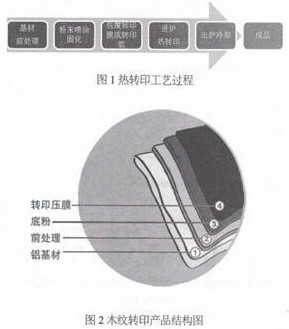
The wood grain heat transfer printing technology involves transferring the special formula ink and printed patterns on the transfer film/paper to the polyester or polyurethane coating through the heat sublimation principle under high temperature and certain pressure.
After cooling and removing the transfer film/paper, the ink remains in the coating, forming a textured pattern that combines with the color of the coating to create a realistic wood grain effect. The heat transfer printing process is shown in the following figure:
Wood grain transfer base powder weather resistance
The weather resistance of the wood grain transfer base powder is mainly determined by the resin used in the base powder. The aging of the coating polymer is mainly manifested in aspects such as change in gloss, color change, and cracking.
- The gloss of the coated polymer
Under the action of light and oxygen, the polymer chains break and are washed away by water, making the surface rough, increasing diffuse reflection and reducing specular reflection, resulting in a decrease in gloss and gloss retention rate.
- Yellowing of coated polymers
After the coating polymer ages, substances such as ketones are formed. These substances absorb blue light (435-480nm), thereby reflecting more yellow light, causing the coating polymer to turn yellow.
- Coating polymer cracking
When the coating polymer ages, as the crosslinking density changes, the internal stress of the coating will increase, and the coating's ability to resist cracking will decrease. Once the internal stress exceeds the force resisting cracking, then cracking problems will occur in the coating
The weather resistance of transfer film/ paper
When designing wood-grain products, it is necessary to ensure that the color of the film and the base powder are as similar as possible. If the color difference between the film and the base powder is too large, it may result in the gray card grade for visual color comparison being less than 4 levels after aging.
Transfer process conditions
The wood grain transfer products use weather-resistant base powder and weather-resistant wood grain film/paper, but they still cannot guarantee the weather resistance of the wood grain products. The weather resistance of the wood grain products is also related to the penetration depth of the ink.
When the transfer temperature is 160℃, the penetration depth of the ink is only 19μ. When the transfer temperature is 180℃, the penetration depth of the ink is 53μ; while when the transfer temperature is 200℃, the penetration depth of the ink reaches 107μ
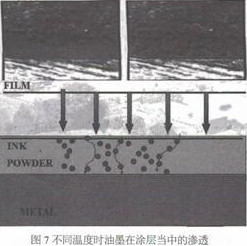
The commonly accepted transference temperature for weather-resistant wood grain patterns is approximately 195 degrees. Once the temperature reaches 195 degrees, the transference process can occur.https://www.lekamaterial.com/https://www.chinacoatingnet.com/